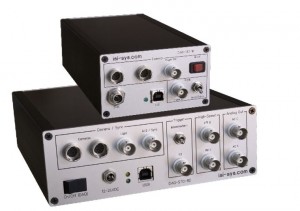
3D-Micro-DIC System

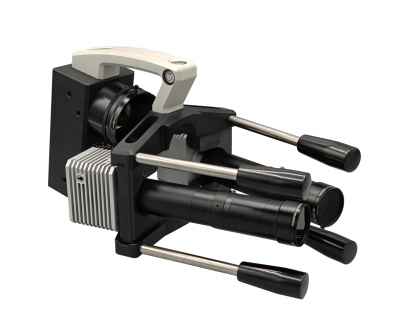
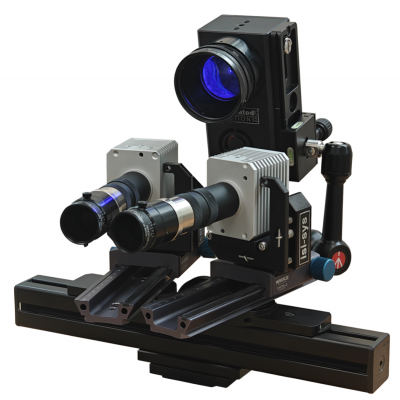
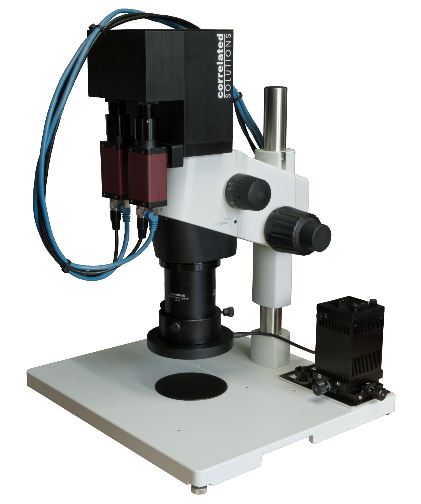
The 3D-Micro-DIC stereo sensor system is developed for full field strain and deformation measurement on small FOV with highest precision and resolution over the complete field of view by 3D digital image correlation (DIC). It also operates as extensometer for real-time stain control. The Example below shows the new sensor version 2019 for 1:1 magnification. FOV range starts from 2:1 with 4.2 x 3.5 mm @ 5Mpx and 75Hz.


Advantages and features of  the 3D-Micro-DIC system:

  • Compact and rigid design, quick set-up and easy handling
  • Pre-adjusted, fixed field of view and stable calibration
  • Specially designed for small and very small field of view (FOV)
  • Reliable and fast USB 3.0 interface for Desktop or Laptop PCs
  • Turn-key solution including Vic-Snap and Vic-Gauge 3
  • DRobust and reliable post-processing with Vic-3D

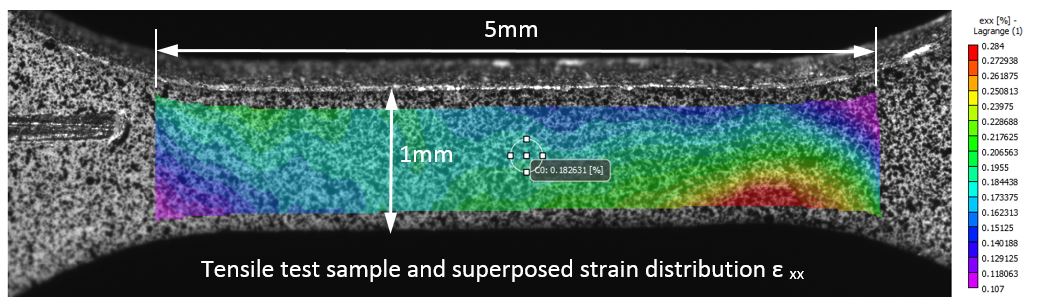
strainograph-test-sample

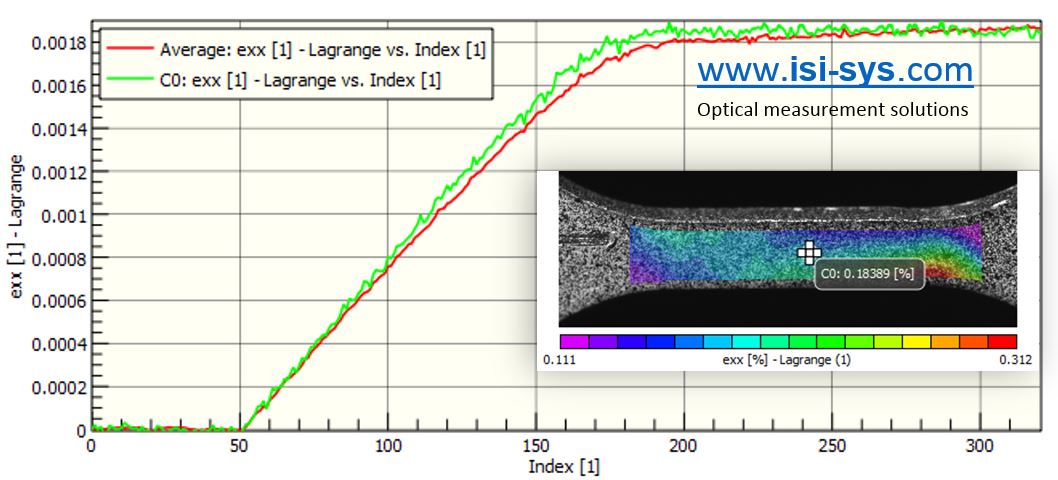
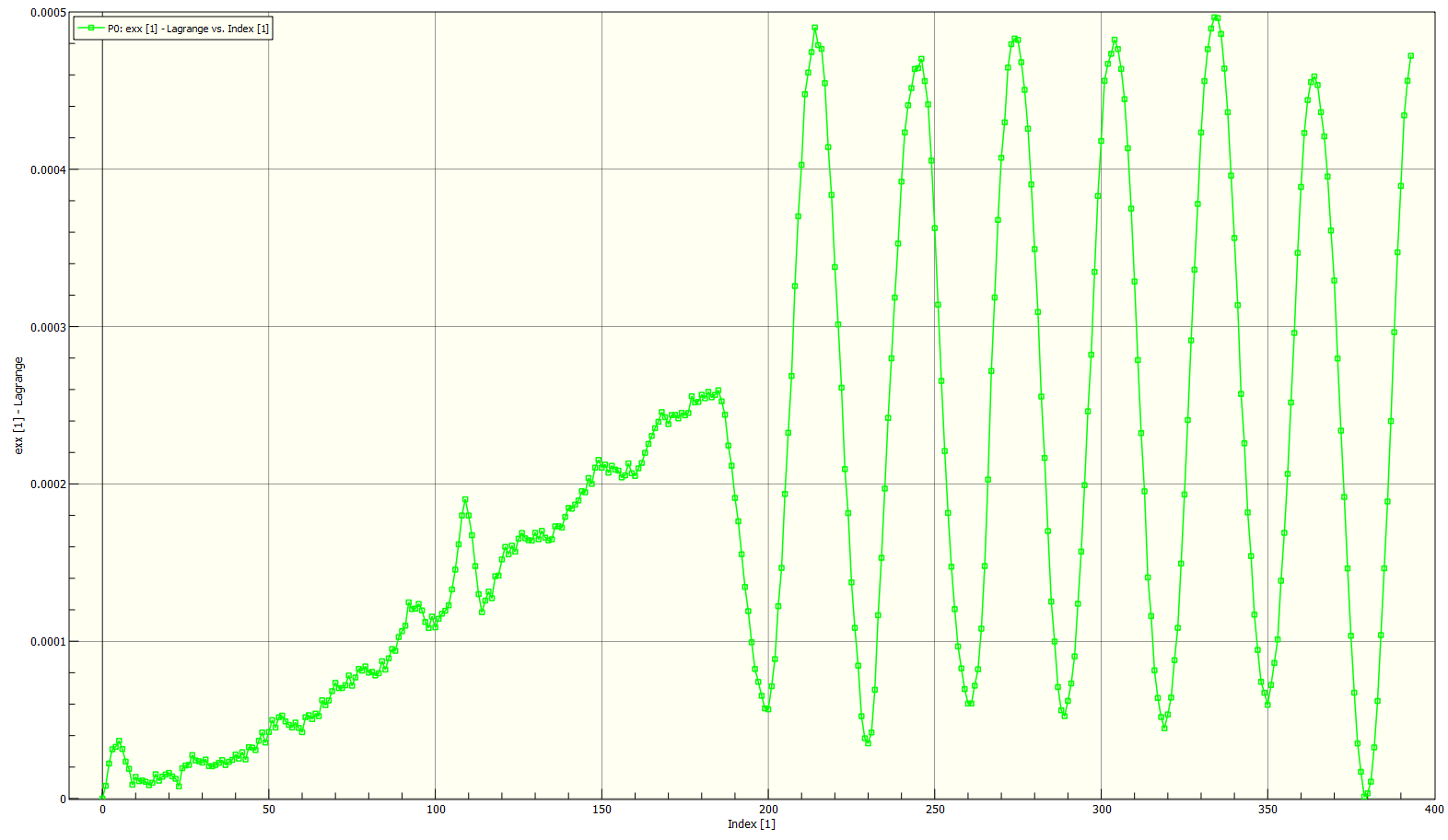
strainograph-diagram

Technical highlights of the 3D-Micro-DIC system

  • 3D full field (5Mpx@75Hz frame rate) continuously recording on SSD
  • Higher framerates at reduced resolution
    (e. g. [Pixel@Hz]: 1600×1200@133; 1920×1080@148; 1280×720@217; 800×600@258; 640×480@315; 320×240@576).
  • suitable for Video-Extensometer functions and real time feedback control
  • Strain noise level of ±0,001% (±10µstrain) and better by time averaging
  • Deformation sensitivity in nm range (1/100 pixel) depending on FOV

Available small FOV versions [mm]

1:2 Magnification (~ 16mm x 12mm @ 2.8 mm FOD)

1:1 Magnification (~ 8mm x 6mm @ 1.2 mm FOD)

2:1 Magnification (~ 4.2mm x 3.5mm @ 0.25 mm FOD)


Data acquisition units (DAQ) for 3D-Micro-DIC

strainograph-daq2

  • Image synchronised analogue data recording (8x differential mode,16 bit, ±10V)
  • 2 x analogue output channels for feedback control (16 bit, ±10V)
  • Camera triggering and (optional) phase synchronisation for periodic signals
  • Fully integrated and supported by all VIC TM software modules

Principle of Digital Image Correlation

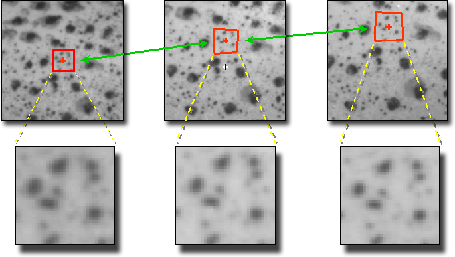
Digital Image Correlation (often referred to as “DIC”) is an easy to use proven optical method to measure deformation on an object surface. The method tracks the gray value pattern in small neighborhoods called subsets (indicated in red in the figure below) during deformation. Digital Image Correlation has been proven over and over to be accurate when compared to valid FEA models. The commercially available VIC-2D and VIC-3D systems from Correlated Solutions both utilize this advanced optical measurement technology.


Digital Image Correlation Overview

Below are the reasons why its versatility, robustness, and ease of use make it the only choice when it comes to digital image correlation.

DIC - Principle of Digital Image Correlation

Two-dimensional Example

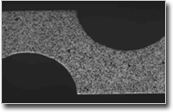
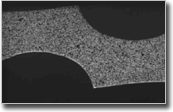
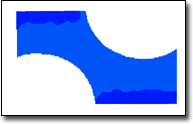
In the two pictures below you can see a speckle pattern on an aluminum sample with two offset semi-circular cut-outs. The two pictures were taken from an animation with the left image taken from the beginning and the right picture taken from the end of the animation. Since the deformation is predominantly in-plane, a single camera can be used to measure the deformation.

VIC2D

Small Deformation

VIC2Da

Large Deformation

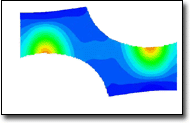
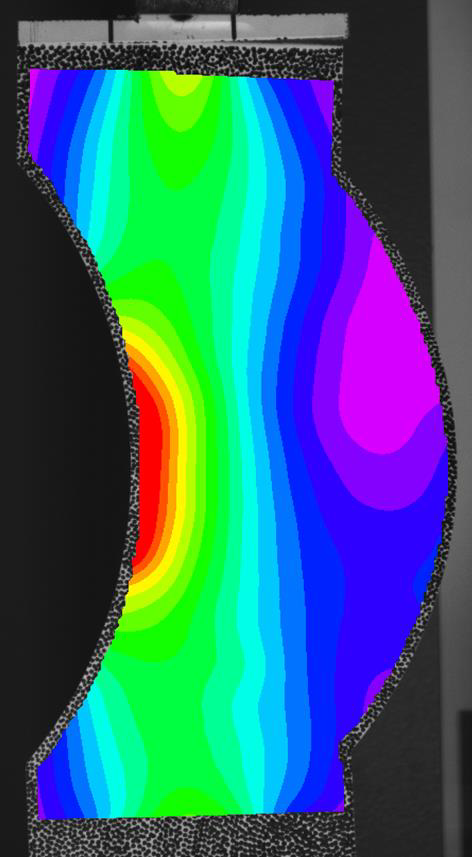
The pictures below show the horizontal strain measured by two-dimensional image correlation for the pictures shown above.

VIC2D-2 VIC2D-2a
VIC2D-2b


Three-dimensional Example

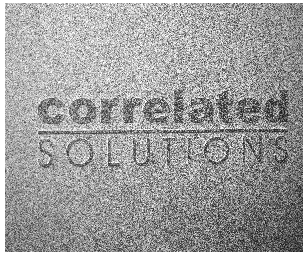
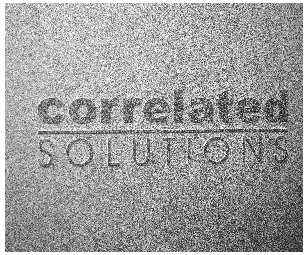
These two speckle images below were taken simultaneously with the left and right camera of a stereo-system. The sample itself is a piece of glass with the company logo sticker adhered to the surface.  The speckle pattern was applied using standard off-the-shelf flat white and black spray paint.  Can you make out the shape?

VIC3Dleft

Left View
VIC3Dright

Right View

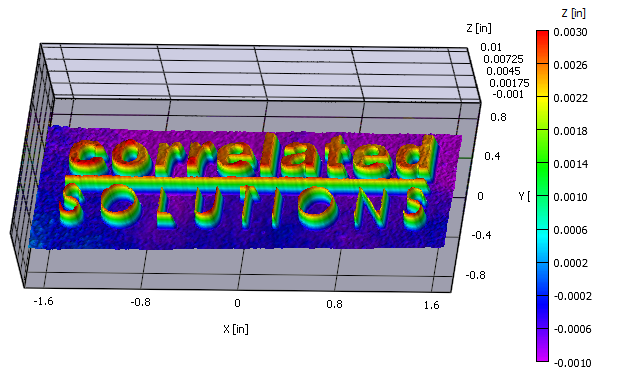
In the plot below the shape of the logo sticker measured with the VIC-3D System is shown. The thickness of the logo sticker is approximately 0.003″ or 0.070mm.

VIC3D-2
For more infomation have a look at our DIC products or contact us via info@correlatedsolutions.eu or +49 561 – 739798-0

Combination of Digital Image Correlation and Thermography

Thermography is based on the principle that induced heat in mechanical components causes a different temperature field in the area of defects or inhomogeneities. The digital image correlation is a powerful system for measuring and visualizing strain, deformation and 3D surface shape.

The VIC-3D IR System features an infrared (IR) camera that is integrated with the DIC cameras enabling temperature data to be accurately acquired and analyzed with the full-field strain and deformation data. The system works by first calibrating the intrinsic optical parameters of the IR camera and then calibrating the position of the IR camera relative to the stereo DIC system. This triangulation allows VIC-3D to place the thermal and strain (or deformation) as well as 3D surface data into a common coordinate system.

The calibration procedure has been streamlined by integrating the IR camera into our VIC-Snap image acquisition software, which allows the user to capture images from the IR and DIC cameras simultaneously. The result is an easy to use turn-key thermal imaging system that utilizes digital image correlation to accurately measure temperature and strain concurrently without any contact with the sample. Thermal and strain data can be viewed, analyzed, and extracted over the entire field or at precise locations.

The system is sold as a turn-key solution which includes all software, hardware, onsite installation, and one year of unlimited technical support and software upgrades giving you piece of  mind that your system functions as intended, so you can start acquiring data immediately. This unique thermal integration capability may also be added to any existing VIC-3D system for increased functionality.

System Configuration and Features

Both the IR camera for thermography and the two CCD cameras for 3D image correlation are mounted on a standard stereo bar.

  • Temperatures up to 2,000C
  • Synchronized IR and DIC images
  • User-friendly setup and calibration
  • Uniquely designed IR calibration targets
  • Analog data synchronization
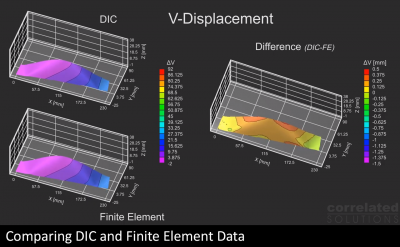
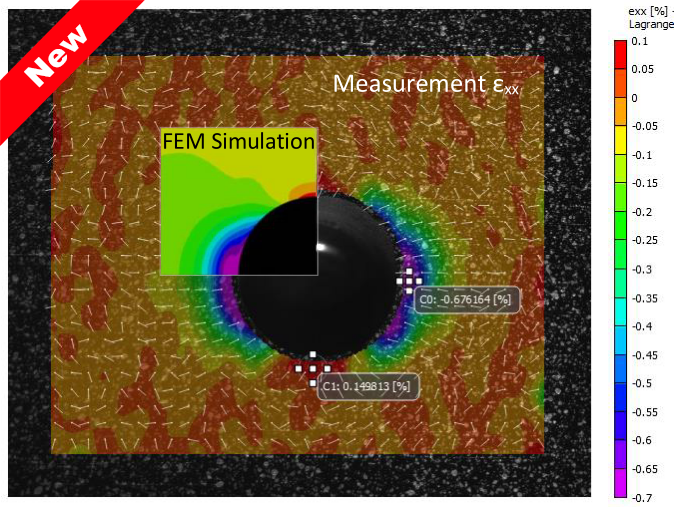
  • Extract points, regions, or node locations for FEA validation
  • Accurately measure deformation and thermal data concurrently
  • Remotely view and acquire images using the Vic-Snap remote
  • Measure 3D full-field displacements and strains
  • All the features for the VIC-3D system included
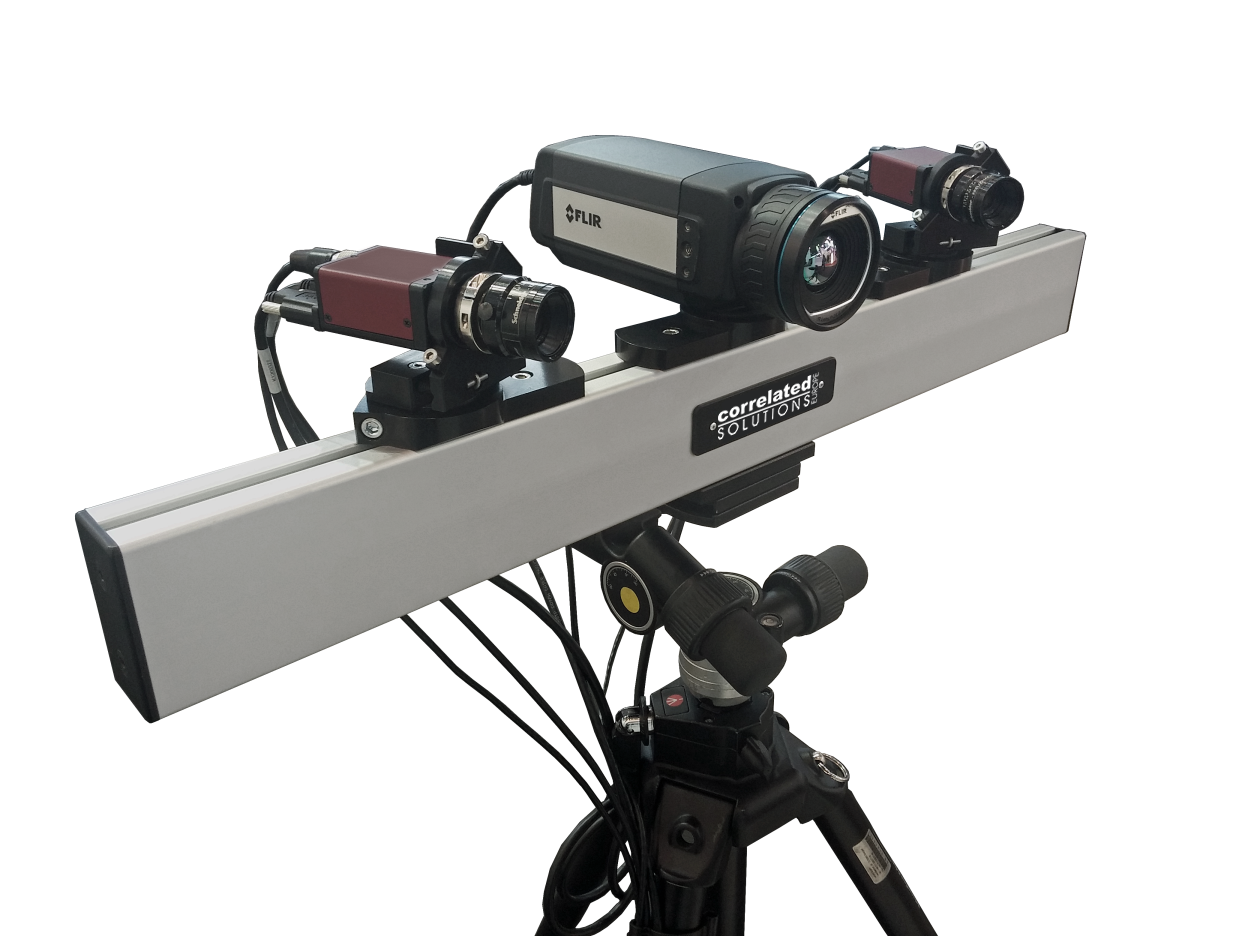
Advantages of this multi-function device are all applications with component deformations caused by thermal energy like current flow. This product allows a simultaneously determination of the heat flows as well as strain and deformation.

Example 1: Photovoltaic Module

Defective photovoltaic modules have been measured during operation over several minutes.  A preparation with speckle pattern is necessary for digital image correlation (here the backside of the panel). The marked areas are heated up due to electric/mechanical errors during operation.
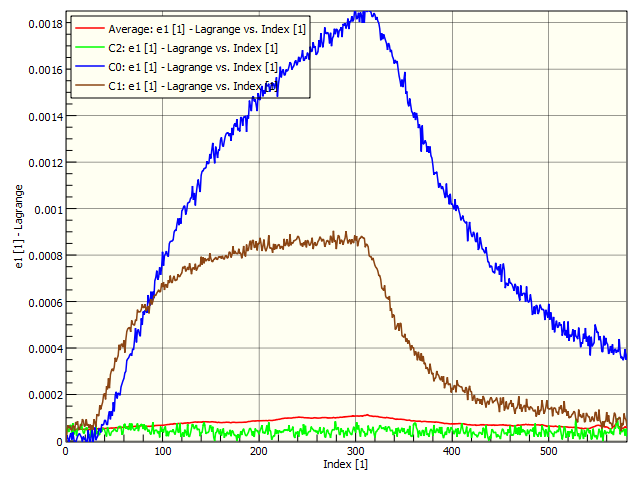
Principal strain (epsilon 1) over time (index) of the points C0, C1, C2 shown in the image below. Following three dimensional presentation of the temperature values.
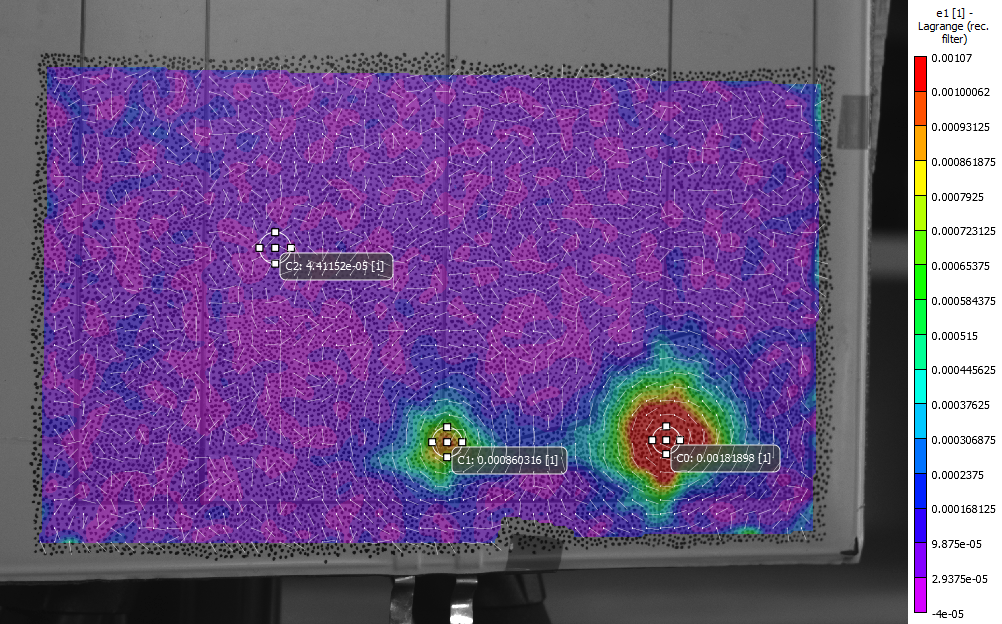
Three dimensional graph of the conture, superposed with the measured temperature (colour scale).

Three dimensional graph fo the conture, superposed with the strain measurement (colour scale).

Example 2: Analysis of simultaneous one-sided heating and compressive loading on an e-glass/vinyl ester/ balsa wood sandwich composite sample

Understanding thermo-mechanical behavior of material can be a vital component when designing vehicles  and structures that may become exposed to high temperatures. Virginia Tech’s Extreme Environments, Robotics, and Materials (ExtReMe) Laboratory focuses on the impact of extreme environments on materials. This includes research that is focused on understanding the thermo-mechanical behavior of materials both during and following fires. Experimental investigations are performed to understand the evolution of the material due to elevated temperature.

The senior research associates in the lab used the VIC-3D IR system to find the effects of a simultaneous one-sided heating and compressive loading test on an e-glass/vinyl ester/balsa wood sandwich composite sample. As one researcher stated, “The VIC-3D IR system identied several transient events during the compression tests which would not have otherwise been fully understood using either DIC or IRT independently. Through this testing, several features of sandwich composite thermomechanical behavior  were elucidated which would not have been possible with traditional point measurements (e.g. strain gages, defectometers, or thermocouples).”
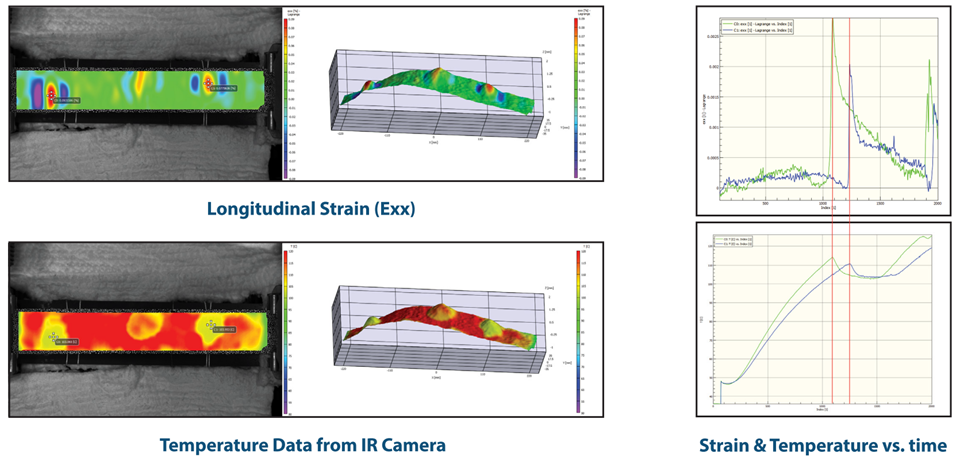
Image above: Analysis of simultaneous one-sided heating and compressive loading on an e-glass/vinyl ester/ balsa wood sandwich composite sample, Identifying several transient events, which  would  not  have been  fully  understood  (stated by the enginners of Virgina Tech´s ExtReMe Laboratory) using  either  DIC  or  IRT independently or only applying traditional  point  measurements  (e.g.  strain gages, deectometers, or thermocouples).  Source:  Virgina Tech´s ExtReMe Laboratory

DIC measurements on structural concrete

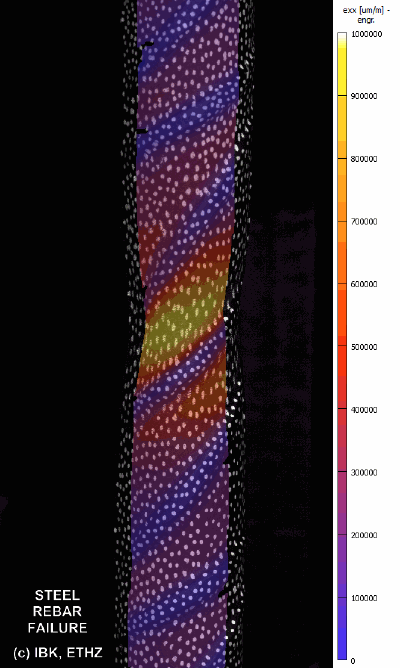
The ETH Zürich – on of our longstanding customers – provides on the following website their research project. They analyse the accuracy of digital image correlation within the scope of reinforced concrete. To the project members belong Prof. Dr. Walter Kaufmann and Dr. Jaime Mata Falcón.

eth-zuerich-2Full field strain measurement in rebar tension

test: failure phase.

User videos on Youtube – Civil engineering

Ravi Ranade

Test of a ECC (Engineered Cementitious Composites) Beam under 4-point loading.


Ravi Ranade

DIC measurement of a rectangular tensile specimen of High Volume Fly Ash ECC, loaded along the horizontal axis.


National Institute of Standards and Technology

The National Institute of Standards and Technology helps to measure stress in bridges. By using Digital Image Correlation they try to understand, what impact stresses and strains have to the failure or damages (tragic collapse) on the metal connectors for bridges.


Vergleich Dehnungsmessstreifen / Vic-3D

Bei dieser Untersuchung ging es um einen Vergleich einer Vic-3D Dehnungsmessung mit den Ergebnissen von Dehnungsmessstreifen. Die ausgewählte Acryl-Probe befestigte man dafür in einer Zugprüfmaschine. An der Probenrückseite wurden die Dehnungsmessstreifen angebracht und mit dem SCAD 500 DMS-Messverstäker verbunden. Die Vorderseite sollte für die Bildkorrelationsmessung verwendet und mit dem benötigten Specklemuster präpariert werden. Zum Einsatz kamen 5Mpx CMOS Kameras mit einem Pregius Sensor und einer Bildrate von 75fps. Weil der Ausgang des SCAD 500 mit der DAQ Box des DIC Systems verbunden wurde, konnten die Ergebnisse der Dehnungsmessung parallel aufgezeichnet und in einem Diagramm dargestellt werden.

X

Strain Gauge Comparison-1  Strain Gauge Comparison-1a

Abbildung 1: Vic-3D Messung der Acryl- Probe


Strain Gauge Comparison-2

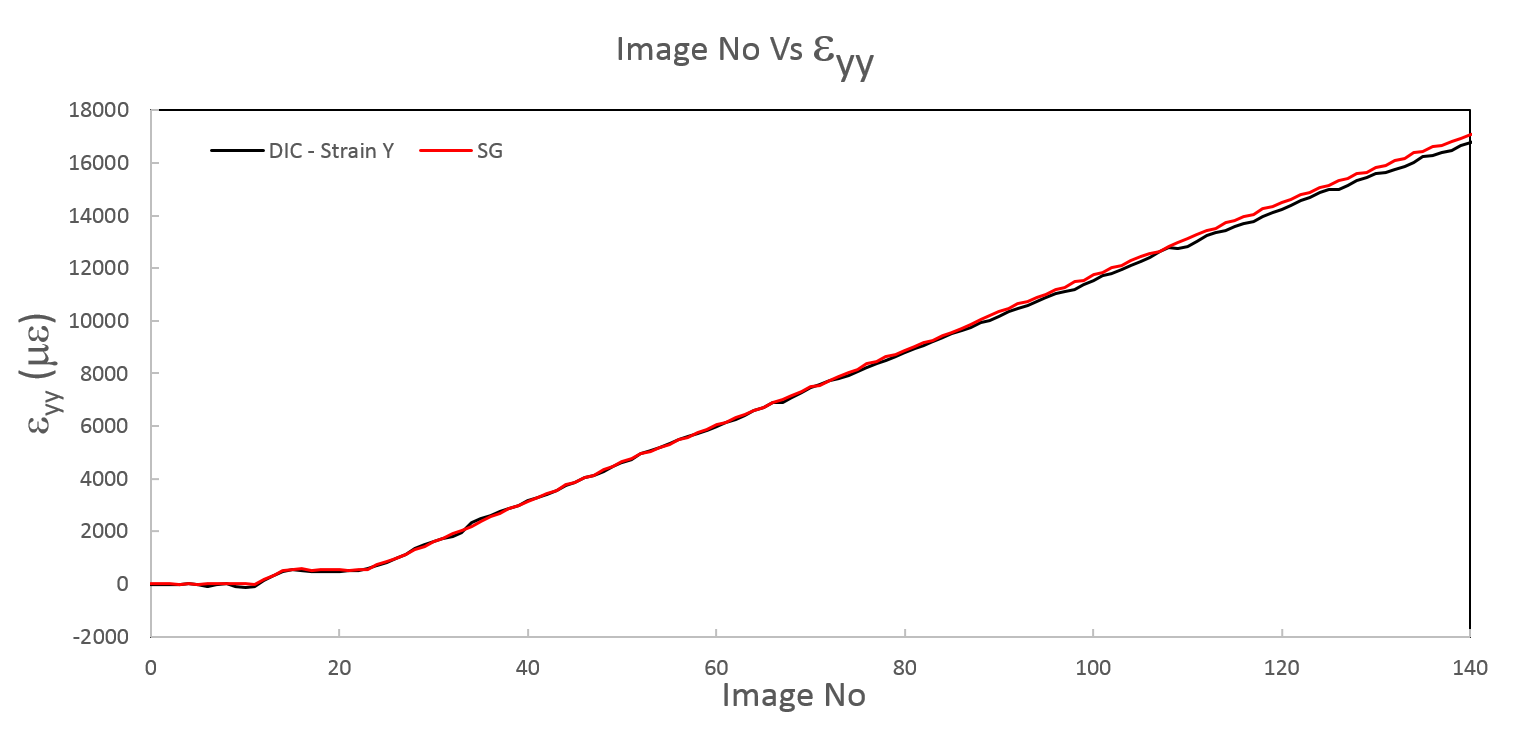
Abbildung 2: Messergebnisse – Vergleich der Dehnungsmessstreifen (rote Kurve) und Vic-3D  (schwarze Kurve) [Dehnung ε in Microstrain]


Die Vic-3D Daten entsprechen nahezu perfekt den Ergebnissen der Dehnungsmessung. Auch bei niedrigen Belastungen ist die Differenz weniger als 25 Microstrain.

Strain Gauge Comparison

In this example a Vic-3D measurement with 5MP CMOS Camera was performed. The acryl specimen is fixed in a tensile testing machine. A strain gauge is attached at the back in combination with a SCAD 500 strain gauge amplifier. The output of the SCAD 500 was connected to the DAQ of the DIC system. The strain results are recorded parallel with the Vic-3D measurement and plotted in a diagram. The camera type is equipped with Sony 5Mpx Pregius sensor, 75 fps.

Strain Gauge Comparison-1  Strain Gauge Comparison-1a

Image 1: Vic-3D measurement of the acryl specimen

Strain Gauge Comparison-2

Image 2: Comparison of strain gauge data (red curve) and DIC Strain data (black curve)

The Vic-3D data match nearly perfect with the strain gauge data. Even at low strains the difference is less than 25 micro strain.

Vic-3D Stereo Microscope

The Vic-3D Micro system is a new addition to the Vic-3D product line of measurement solutions. Vic-3D Micro enables accurate displacement and strain measurements under high magnification.

BackgroundStereomikroskop2

Three-dimensional digital image correlation (DIC) has found widespread popularity for strain measurements due to its excellent accuracy, robustness and ease of use. However, 3D measurements have been difficult to obtain on specimens where high magnification is required. This is mainly due to the lack of optics with sufficient depth-of-field to acquire two high magnification images from different viewing angles.

Stereo microscopes overcome these depth-of-field limitations. However, the internal construction of stereo microscopes prevents proper correction of image distortions using traditional models, such as Seidel lens distortions. These uncorrected images will result in severely biased shape and strain measurements. In fact, it is not uncommon to observe bias levels of several thousand microstrain.

To overcome this problem, Correlated Solutions, Inc., has developed and patented an easy-to-use calibration method that does not suffer from the problems associated with traditional parametric distortion models. The calibration method computes the non-parametric distortion fields of the stereo microscope and has been shown to completely eliminate shape and strain bias from the measurements.

System Features

  • Field of view (zoom range): 0.8mm-7mm
  • Full-field measurements of 3D coordinates, displacements, velocities, and complete strain tensors
  • Automatic calibration
  • Image pairs can be automatically overlapped with a simple adjustment
  • Powerful tools for visualizing data
    • Contour displays which can be overlaid onto images of the test specimen
    • Data extraction from 3D plots based on user defined lines and circles
    • Post-processing tools for statistical analysis, stress-strain curves, and more
  • Convenient exporting of data with the FLEXPort data tool
    • Data can be exported in Tecplot/plain ASCII, Matlab, and STL formats
    • Node data can be easily extracted for FEA validation
  • One year of technical support and software upgrade
  • One-year replacement warranty for defects in materials and/or workmanship on all parts

Application examples about Vic-3D Micro:

Servered ceramic capacitor chip under bending load

Combination Stereomicroscope and Vic-3D digital image correlation

Combination of Fulcrum and FFT module

The combination of the new Vic-3D FFT-Module and the known synchronisation / trigger device with Fulcrum module of isi-sys GmbH / Correlated Solutions INC for Vibrocorrelation permits full modal and vibration analysis using conventional low speed cameras. It can be applied on objects with high frequency excitation, which can replace High-Speed (HS) cameras, when conventional shakers are used for excitation.


Excitation signal

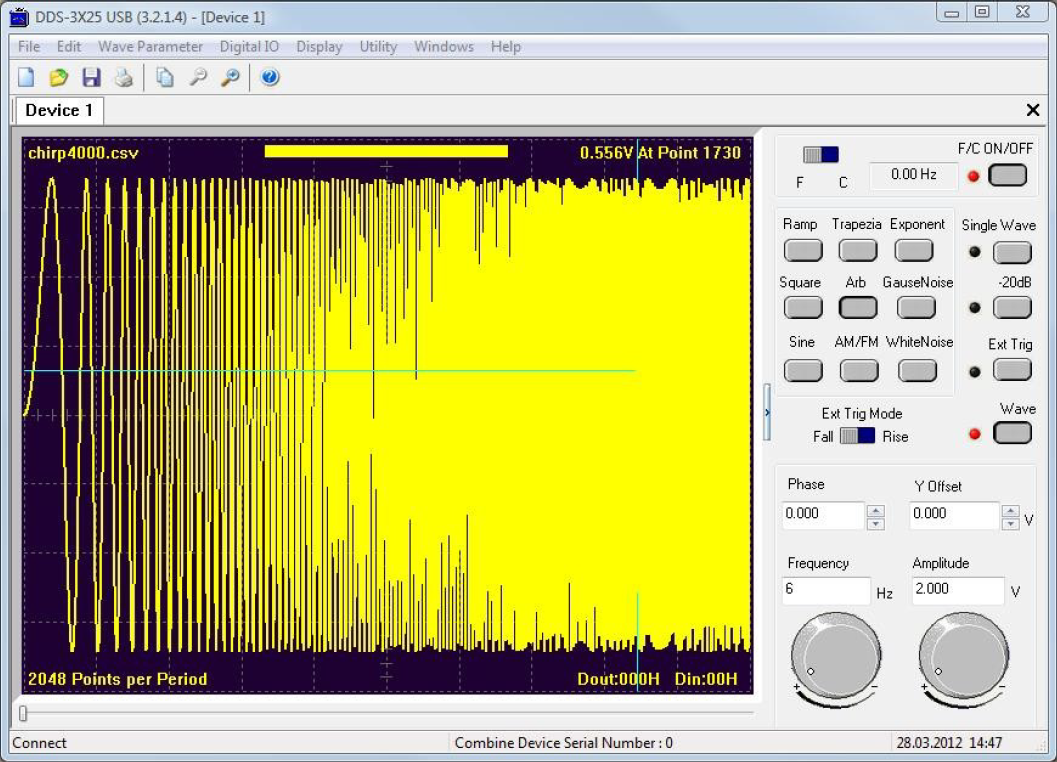
A periodic vibration signal with a wide frequency spectrum (e. g. chirp, fast sweep) is applies to a structure via an electrodynamic, hydraulic or piezo shaker. The cameras of a stereoscopic system are set to a short exposure duration (we use 200μs here) and they are triggered though the Fulcrum module of Vic-Snap.

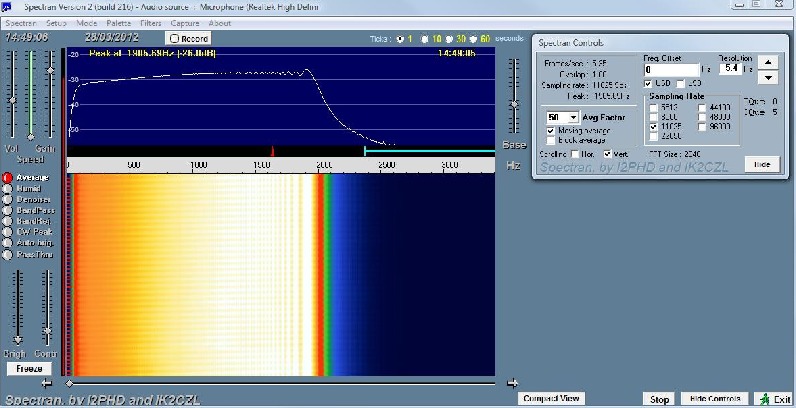
The excitation signal is shown in the images below. A pulse is generated by the function generator for each cycle of the excitation (chirp) signal and connected to the synchronisation device below.

Anregungssignal

Image 1 – Frequency spectrum

Anregungssignal 2

Image 2 – Excitation signal


SynchronisationTrigger device


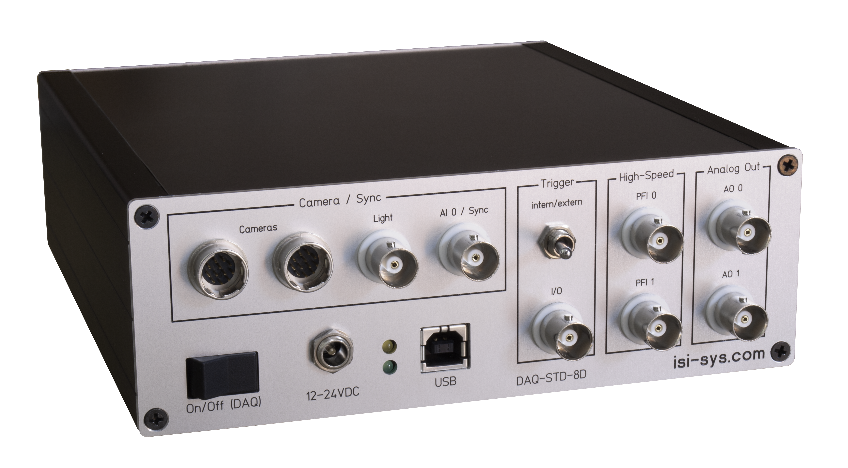
The cameras are triggered through the standard synchronisation/trigger device  DAQ-STD-8D controlled by the Fulcrum Module for Vic-Snap/ Vic-3D.


FFT Module Evaluation Examples

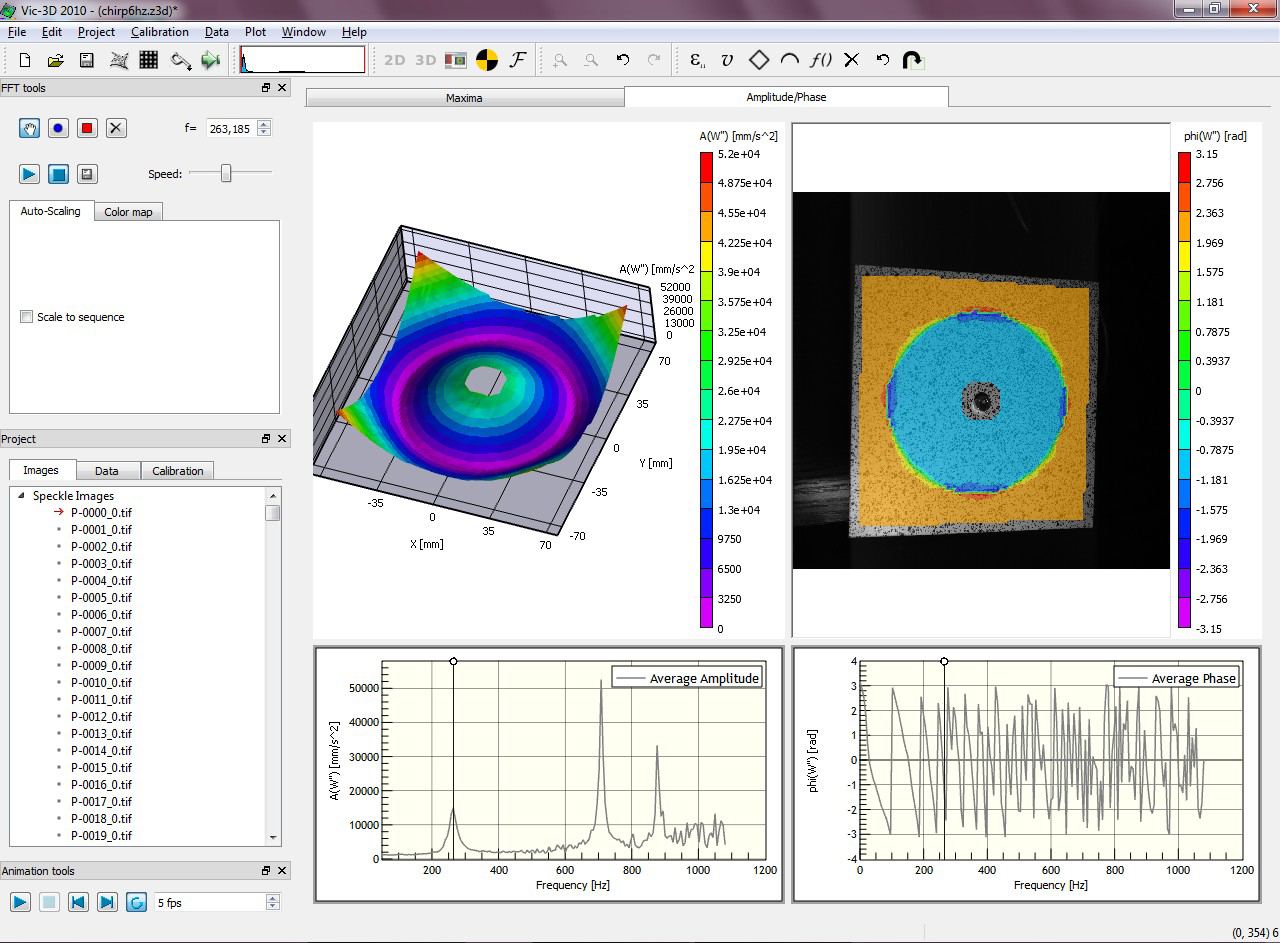
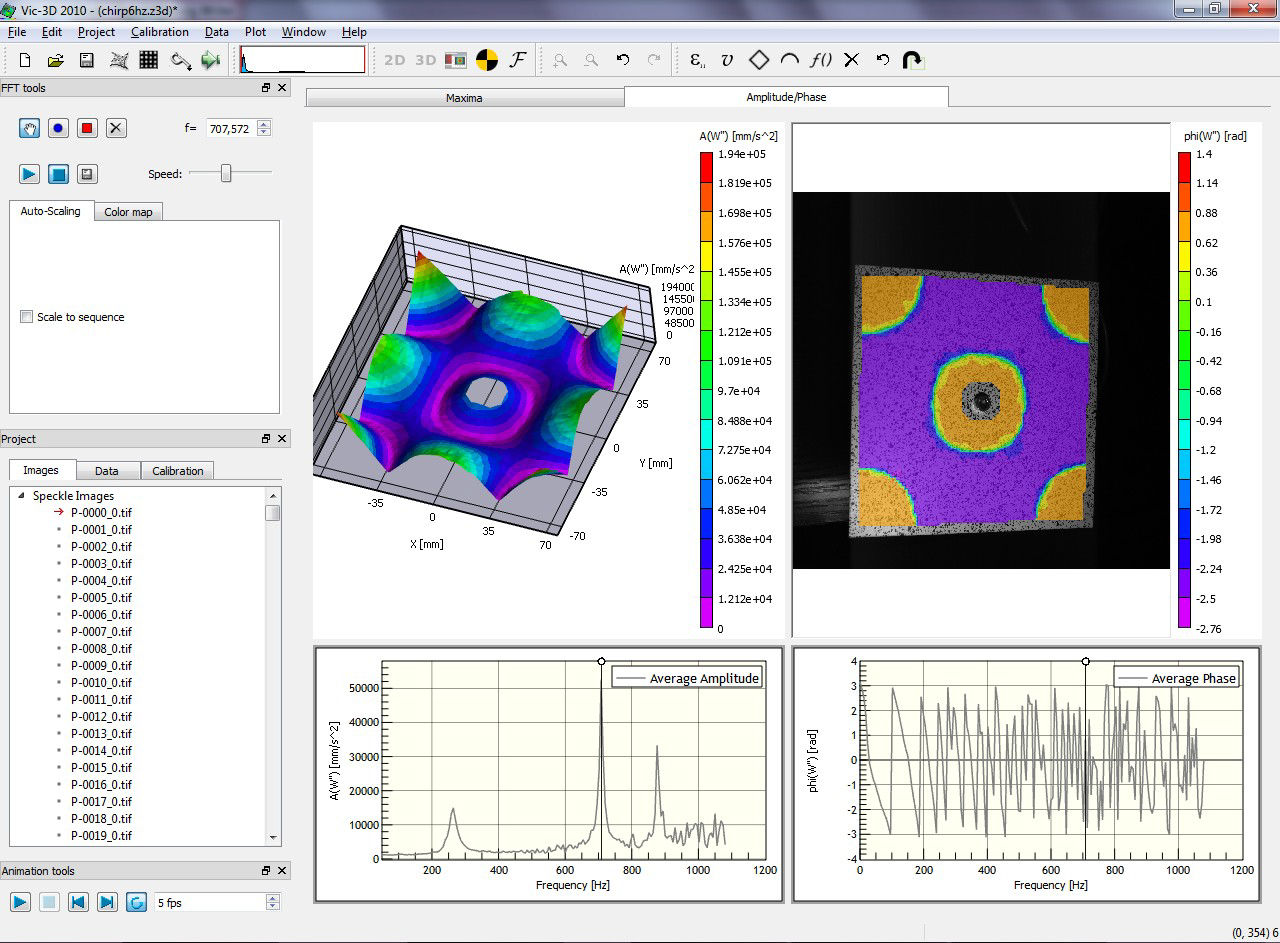
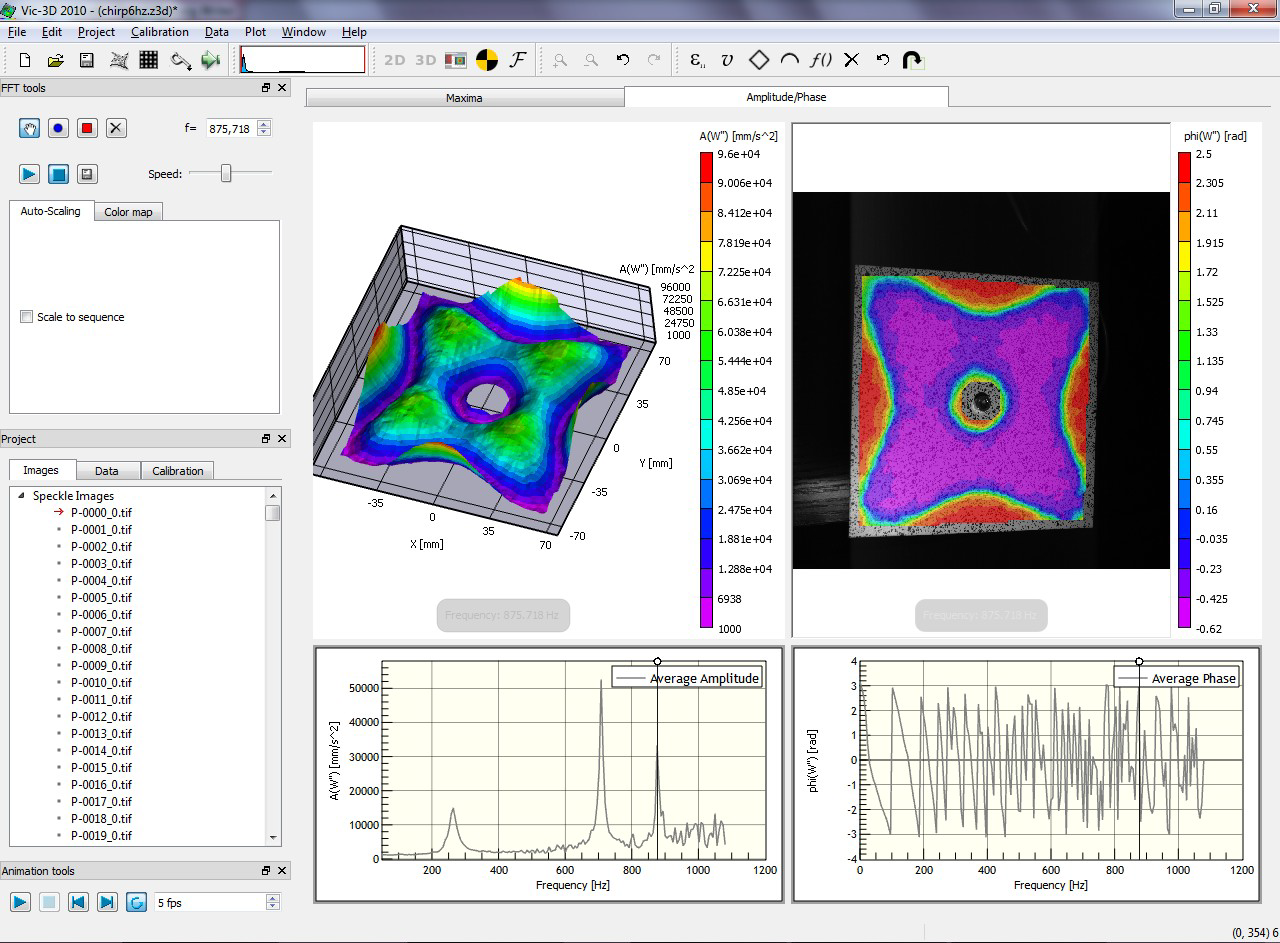
The following results show the workspace of the FFT Module in Vic-3D with amplitude (left) and phase (right). Shifting the frequency value in the graphs below (amplitude or phase vs frequency) permits to select the corresponding mode shape for any analysed frequency. The amplitudes (left) are displayed here as 3D plot, other options are e.g. generation of animated videos of the mode shape vibration.

The results on a sqare plate 140 x 140mm of different resonance frequences are shown in the images below.

263Hz

Image 3 – Resonance at 263 Hz


707Hz

Image 4 – Resonance at 707 Hz


875Hz

Image 5 – Resonance at 875 Hz


Application example of the FFT module:

Operation mode analysis on a mobile phone during vibration alert